Espresso water and scale: what to check first
Choose water for the machine you own, not for a generic internet recipe.

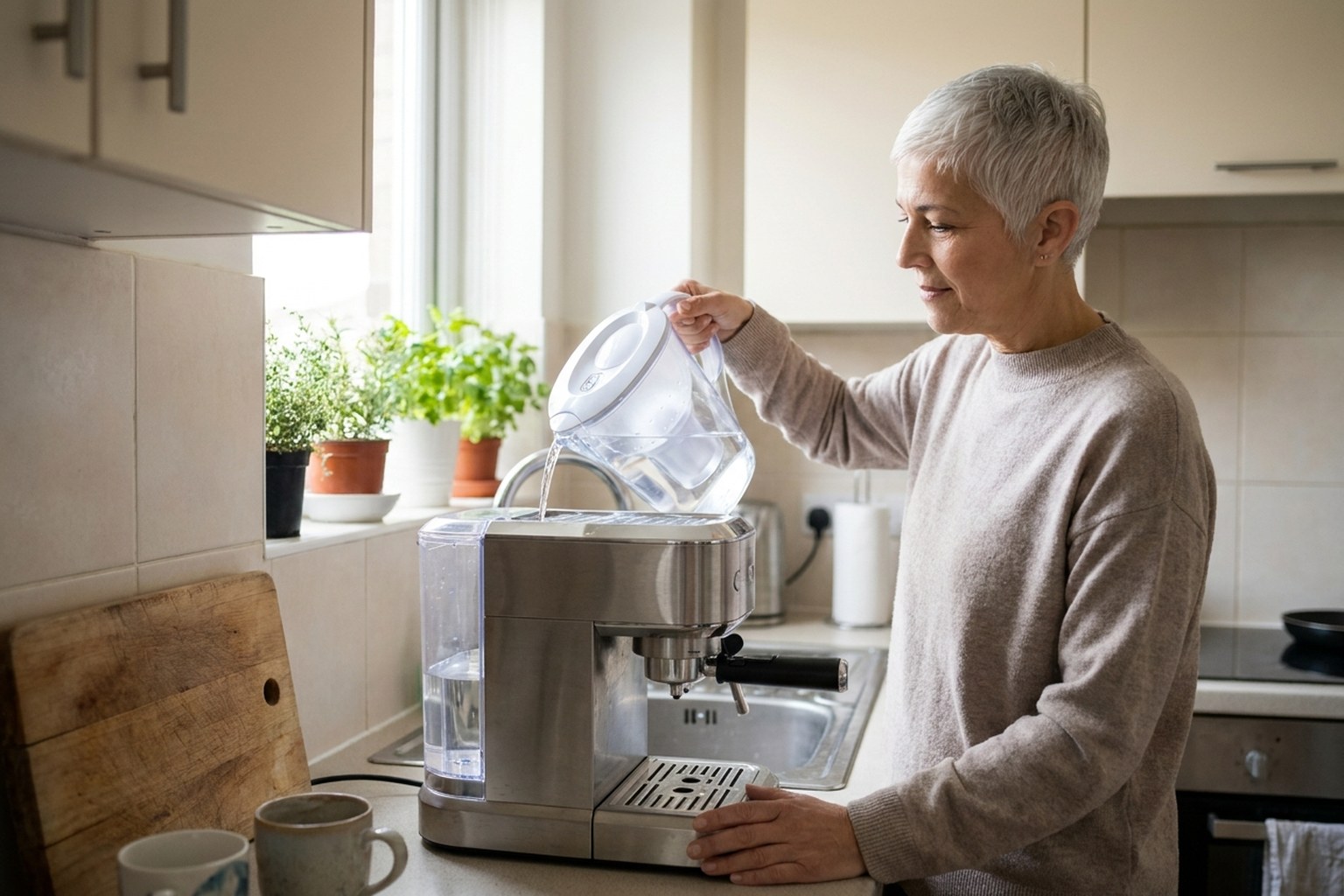
Your water does more to your machine, and your shot, than most people expect. Start with what the maker of your machine recommends, then look honestly at where your water comes from and how you look after the machine. This guide helps you sort those decisions out, without inventing a mineral recipe or a descaling calendar that fits everyone.
Our rankings for this: espresso cleaning products and descalers for breville.
Affiliate disclosureAs an Amazon Associate we earn from qualifying purchases made through links on this page. Commissions never change our ratings.
Find the instruction that applies to your machine
Locate the exact model code and region before downloading a manual. A familiar family name is not enough if the controls, tank or maintenance routine changed between versions. Search the manual for water, filter, hardness and descaling. Keep those passages together so you can see whether a recommendation concerns everyday filling, a replaceable filter or a cleaning operation.
For a concrete example, the Bambino US instruction book specifies cold mains or tap water and advises against highly filtered, demineralized or distilled water for that model. Do not transfer that wording to every espresso machine. Its value here is to show why a universal recommendation to use the purest possible water is inadequate. If your machine's requirements are unclear, ask its manufacturer with the full model code. Our compact machine buying guide suggests checking these responsibilities before purchase rather than discovering them afterward.

Separate what you know from what you assume
Write down whether you fill from a tap, a household filter or packaged water. If you use a filter, identify what the actual product documentation says it does. Do not assume that a familiar brand name tells you how a particular cartridge treats water. Keep installation and replacement instructions with it, including any limits on the water source for which it is designed.
A useful water record can be simple: source, treatment device if any, date a cartridge was fitted and any change you noticed. A taste impression is an observation, not a laboratory analysis. If the machine manufacturer asks you to check hardness or another property, use the procedure and interpretation it specifies. Do not convert one kind of test result into another using an improvised formula. The goal is a defensible maintenance decision, not a dashboard of numbers whose relationship to your appliance is unknown.
Keep the measuring instructions with your maintenance notes.
Keep descaling separate from other cleaning
Use precise names when buying maintenance supplies. A product intended to remove coffee residues is not automatically a descaler, and a descaler is not a general replacement for the rest of a cleaning routine. Urnex's maintenance FAQ distinguishes descaling, which addresses mineral scale, from other equipment cleaning. That distinction helps classify a product; it does not establish that the product is approved for your machine.
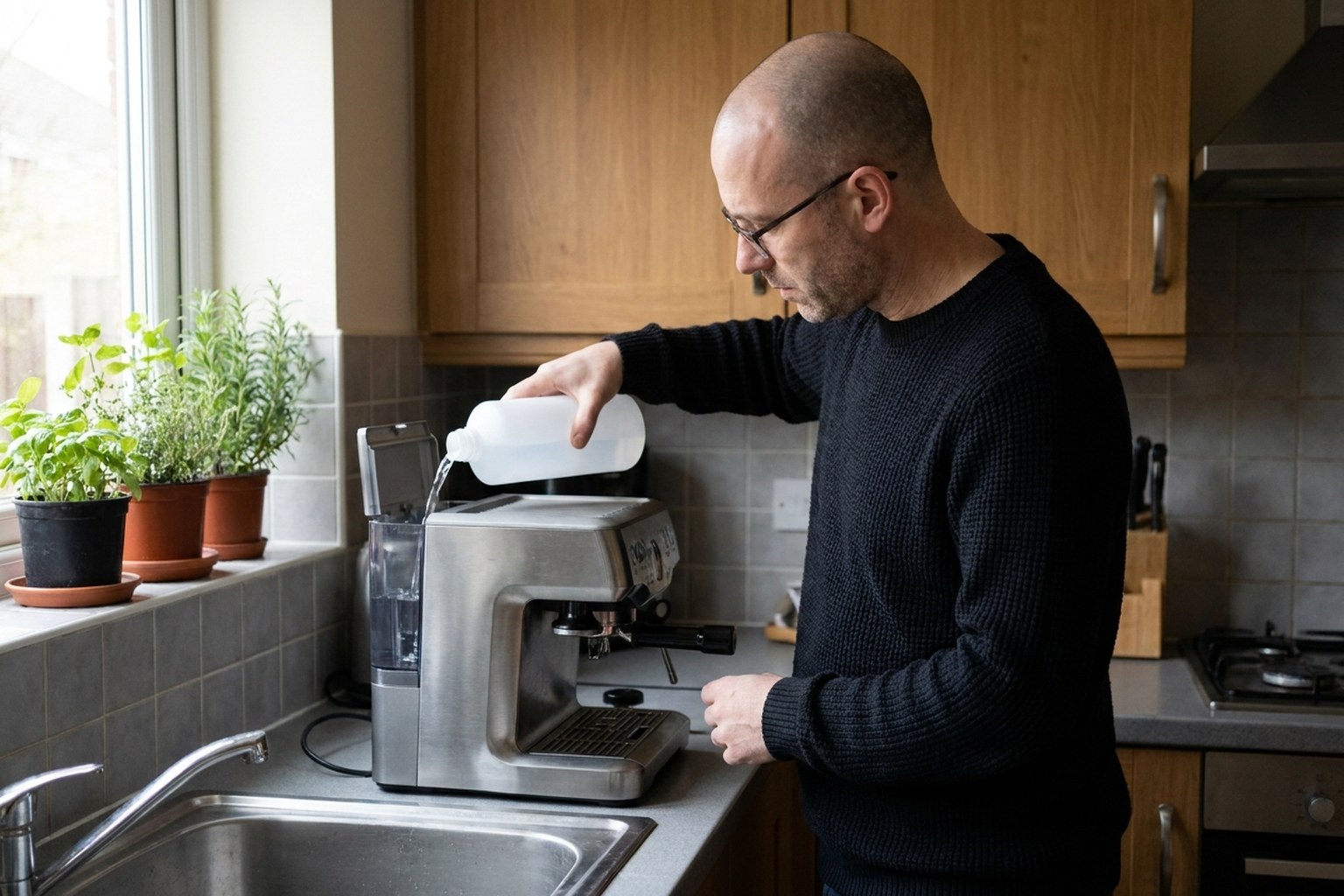
Check both the appliance manual and the exact cleaner label before use. Confirm purpose, supported equipment, dilution if required, procedure and rinsing. Never improvise a stronger mixture to make a process seem faster. Do not combine maintenance chemicals. Our machine cleaning guide provides a way to organize separate tasks so a coffee-oil cleaner is not confused with a tank treatment. Keep containers identifiable and stored according to their labels, away from drink preparation and children.
Build a maintenance record around evidence
Start with the manufacturer's schedule or alert instructions. Record when a maintenance task was completed and which product was used. If the instructions require an adjustment based on water information, keep that information with the record. Avoid adopting a fixed monthly interval merely because it worked in another household. Different equipment and instructions may require a different approach.
When a warning appears, identify its meaning from the exact manual rather than assuming all flashing lights request descaling. If the warning persists after the specified procedure, contact support with the steps you actually followed. Repeating chemical cycles without a diagnosis is not a substitute for troubleshooting. Save a photograph of the indicator if that can be done safely, and note whether the symptom occurs during startup, brewing or another function. This gives support a more useful report than a conclusion that the machine must be full of scale.
Choose supplies after resolving the water question
The cleaning-category cards on this page offer places to investigate supplies, not a declaration of compatibility. A brush, cleaning tablet and descaler may all belong to maintenance while serving different tasks. Read the exact title and package instructions before deciding whether an item answers your need.
If coffee behavior changes, do not blame water by default.
- Check the observation sequence in our espresso troubleshooting guide and note any other recent changes.
- A new coffee, different preparation routine or missed cleaning task deserves attention too.
- Resolve one question at a time and retain the normal procedure that the manufacturer supports.
- A useful water plan ends with a known source, appropriate documented treatment if required, and a maintenance record you can follow.
- It does not end with an unverified chemical recipe or a promise that one bottle suits every espresso machine.
| Section | Key point |
|---|---|
| Find the instruction that applies to your machine | Search the manual for water, filter, hardness and descaling. |
| Separate what you know from what you assume | Keep the measuring instructions with your maintenance notes. |
| Keep descaling separate from other cleaning | Do not combine maintenance chemicals. |
| Build a maintenance record around evidence | Start with the manufacturer's schedule or alert instructions. |
| Choose supplies after resolving the water question | If coffee behavior changes, do not blame water by default. |
Our rated picks
The three best-rated models of our espresso machine cleaning products ranking, from the buyer review record and the listed specs.


Product images: Amazon listings